
Ask "how much do the Chinese help illegal mining in the Amazon," and the honest answer is not a single number. Chinese actors almost never run the mines and almost never carry the guns. What they do, across the Guianas, Bolivia, Brazil and Venezuela, is supply the credit, the machinery and the mercury going in, and buy the gold coming out. In two regions that enabling role is close to structural: pull it and the illegal economy contracts sharply. In others it is one node among many. And in the Colombian Amazon, the country this Journal watches most closely, it is essentially absent. This dossier sets out what the reporting actually supports, region by region, and where it does not. It sits alongside our corridor coverage: the bioceanic railway, the Chancay corridor, and the mercury thread running through our editorial on the tipping point. Every source link was verified; two dead or blocked links were replaced, disclosed at the end.
In this reportJump to a section
The distinction the headline hides
The single most important thing to hold onto is a distinction the phrase "Chinese involvement" tends to erase. The evidence describes three very different actors, and conflating them turns a supply-chain investigation into a xenophobic caricature:
- Diaspora trading networks, largely Chinese-run shops and firms operating legally as merchants in Suriname, French Guiana, Bolivia and Brazil, who in practice finance and equip illegal mining. This is where almost all the documented weight sits.
- Chinese market demand, the refineries and buyers in Hong Kong and mainland China that pull the gold and, increasingly, strategic minerals out of the region.
- The Chinese state and its firms, which appear only thinly and mostly on the legal side (a state miner buying a licensed Brazilian mine, concessions in Bolivia, export contracts with Venezuelan state hubs). There is no documented evidence of Beijing directing illegal mining.
The Foundation for Strategic Research, in its 2023 field study of French Guiana, put the point precisely: the illegal gold there is dug by Brazilian garimpeiros, but it is "made possible by Chinese actors, whose role is essential albeit indirect." Essential, and indirect. That is the whole story in four words.
The mercury bracket
The most underplayed part of the story is chemical. Illegal gold mining runs on mercury, and mercury is where the two ends of the Chinese role meet. Networks that supply the mercury flowing into the pits are frequently the same networks buying the gold flowing out. The Environmental Investigation Agency's 2025 "Toxic Tons" investigation traced the largest documented flow of illegal mercury into the Amazon, the poison that ends up in the rivers and the bloodstreams of Indigenous communities downstream (EIA). When a single commercial network brackets both ends of that cycle, supplying the contaminant and purchasing the product, it is not a peripheral vendor. It is the circulatory system of the trade. This is the thread that connects a customs seizure to a poisoned child, and it is the strongest, most defensible reason the Journal follows this story at all.
How the poison works
Mercury. Miners stir liquid mercury into crushed ore or river sediment; it binds the fine gold into a solid lump called an amalgam, separating it from worthless sand with no skill or machinery needed. They then burn the amalgam with a blowtorch to boil off the mercury and leave the gold, releasing mercury vapor into the air and the rest into the water. Roughly 1 to 2 grams of mercury are lost to the environment for every gram of gold produced.
Into the body. The route into a community is the river and the dinner plate. Mercury that settles into river sediment is converted by bacteria into methylmercury, which fish absorb and concentrate as it climbs the food chain, so the large predatory fish that are the main protein for riverside and Indigenous communities carry the heaviest load. People are poisoned by eating that fish, often daily: the gut absorbs methylmercury almost completely, and it crosses both the blood-brain barrier and the placenta. Miners and mining-town residents also inhale mercury vapor directly from burning the amalgam.
What it does. The damage is neurological and cumulative. In adults it brings numbness and tremors, loss of coordination and balance, tunnel vision and hearing loss, and kidney damage. In the unborn and in infants it crosses the placenta and causes irreversible brain damage, the same syndrome first identified as Minamata disease in Japan, after which the global mercury treaty is named. It is rarely a single dramatic death; it is the slow disabling of nervous systems across a whole population, and testing in some Munduruku and Yanomami villages has found most or all of those sampled carrying mercury above safe limits.
Cyanide. The second workhorse, used to dissolve gold out of low-grade ore and out of the leftover tailings that amalgamation missed, which is what Peru's 62,000-tonne tailings-to-China scheme was built on. Applied over mercury-laced tailings it forms mobile mercury-cyanide complexes, the worst-case combination, and spills kill rivers outright.
And the rest. Nitric acid and aqua regia refine the gold; diesel and hydraulic oil from the pumps and dredges foul the same water; borax is the main mercury-free alternative but stays rare because mercury is cheaper. Most of the mercury and cyanide is imported, and the networks that finance the mining are frequently the ones supplying it, the inflow the mercury bracket describes.
How much they help, graded by region
The Guianas shield (French Guiana, Suriname, the Maroni border): structural. This is the strongest version of the thesis. An estimated 120 Chinese trading posts along the Surinamese bank of the Maroni supply equipment and daily necessities to the work sites and finance them, and the transnational networks around them launder close to ten tonnes of illegally mined gold a year. The mining is done by Brazilian garimpeiros; the logistics pivot is Chinese. Remove that layer and the trade does not simply shrink, it loses its supply chain. The pattern was confirmed again in early 2026, when Interpol coordinated a cross-border operation across the region that produced 198 arrests (Interpol; French Guiana findings summarized by Le Monde). Suriname's role as conduit is documented in the tracing of its illicit gold proceeds (Global Americans), and the human cost of the wider extractive push on tribal land is laid out by The Guardian.
Bolivia (north La Paz, Madidi, Pando): direct and heavy. Investigations describe dozens of Chinese companies operating behind mining cooperatives in the northern La Paz gold rush, "on paper they do not exist," hiding behind cooperatives that take a cut for the secrecy (Infobae, republishing the Los Tiempos investigation). A later mapping counted Chinese dredges among 63 mining actors devouring tens of thousands of hectares of Amazon forest (ANA Bolivia). The cooperatives themselves function as the local crime nexus, colluding with a permissive state (Climate Diplomacy). Here the Chinese role is capital and equipment, close to structural.
Brazil (Amazonas, Pará, Roraima): important but replaceable. The mines are run by Brazilian garimpeiro mafias and drug factions, above all the PCC and Comando Vermelho. Chinese actors sit at two points in the chain: financiers and equipment traders who loan money and sell pumps, mercury and heavy machinery, and buyers who move the gold onward, with 2025 seizures of over 140 kg in Roraima and Pará linked to onward flows toward China (Infobae). Real, but one node among many, and not the node holding the guns.
Venezuela (Bolívar, Amazonas): diffuse, and the most strategically significant. Here armed groups, ELN and FARC-dissident fronts, control the pits, and Chinese actors appear as buyers and traders. Miners' testimony describes "the same Chinese buyers working together with the ELN," and state processing hubs have exported concentrates to Chinese firms (InfoAmazonia). This is the region where the story stops being only about gold, which we return to below. It is also where the evidence is most testimonial, and we flag it as such.
Peru, Colombia, Ecuador Amazon: absent on the ground. No reporting documents Chinese financing or equipping of illegal mining inside the Peruvian, Colombian or Ecuadorian Amazon. What exists sits outside those forests: a scheme exporting 62,000 tonnes of gold- and copper-bearing tailings from Arequipa to China (OjoPúblico), and Chinese businessmen reportedly driving illegal gold mining in Andean Cajamarca (Infobae). In these countries China is the end market, not a presence in the pits.
Chinese involvement by region, at a glance
| Region | Who runs the mines | Chinese role | Minerals | Strength of evidence |
|---|---|---|---|---|
| French Guiana / Suriname | Brazilian garimpeiros (PCC/CV) | Trading posts: equipment, finance, laundering (~10 t/yr) | Gold | Strong (field study + Interpol op) |
| Bolivia (N. La Paz, Madidi) | Mining cooperatives | Firms behind co-ops: capital, dredges | Gold | Strong (documented firms, exports) |
| Brazil (Amazon states) | PCC, Comando Vermelho | Financiers, equipment traders, buyers | Gold | Moderate |
| Venezuela (Bolívar) | ELN, FARC dissidents | Buyers; state-hub exports to Chinese firms | Tin, coltan, gold, rare earths | Testimonial + trade records |
| Peru Amazon | Local mafias | None documented in-forest; end market only | Gold | Absent in-forest |
| Colombia Amazon | FARC dissidents, ELN | None documented (see caveat) | Gold | Absent |
| Ecuador Amazon | Mexican/Colombian gangs | None documented | Gold | Absent |
From gold to strategic minerals
The part of this story with real geopolitical weight is the newest and least developed: the shift from gold to strategic minerals. In 2023 Venezuela declared tin, coltan and rare-earth elements strategic and built state processing hubs in Bolívar, with concentrates flowing to Chinese smelters (InfoAmazonia). Gold funds crime; coltan and rare earths feed an industrial supply chain, and that is where illegal Amazon extraction stops being only an environmental story and becomes a corridor story. The same Pacific-facing logistics geography that the bioceanic railway and the Chancay port are built to serve is the geography that would move these minerals out. Analysts have already flagged the new Chinese-run port infrastructure as a potential channel for illicit flows, though no specific case has yet been published (Diálogo Américas).
What surface mining leaves behind
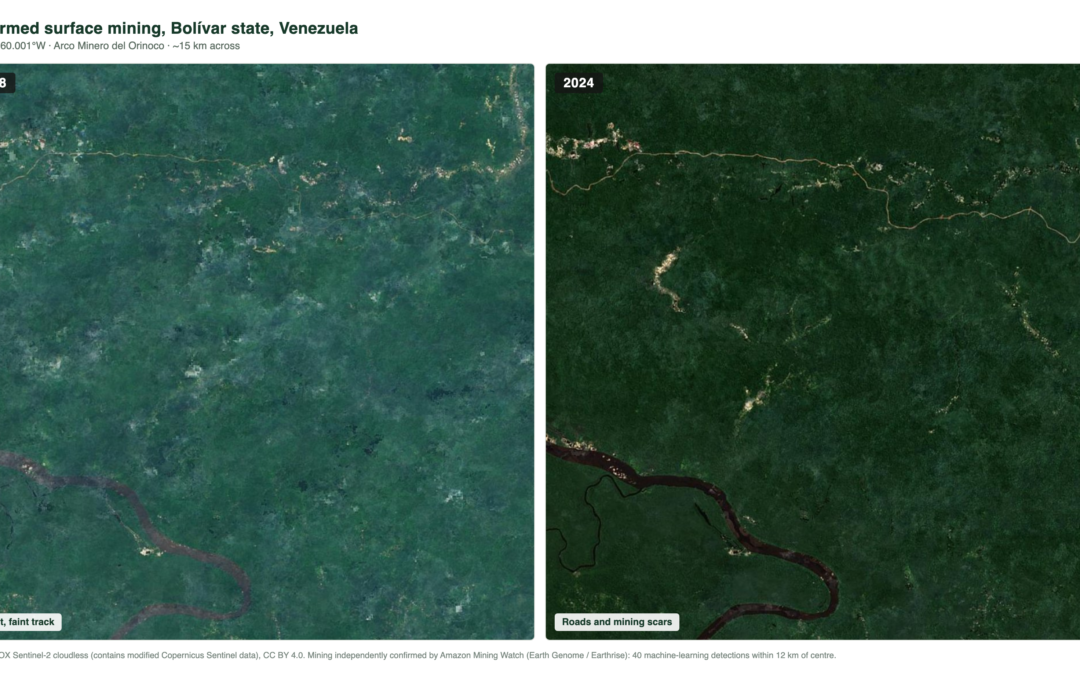
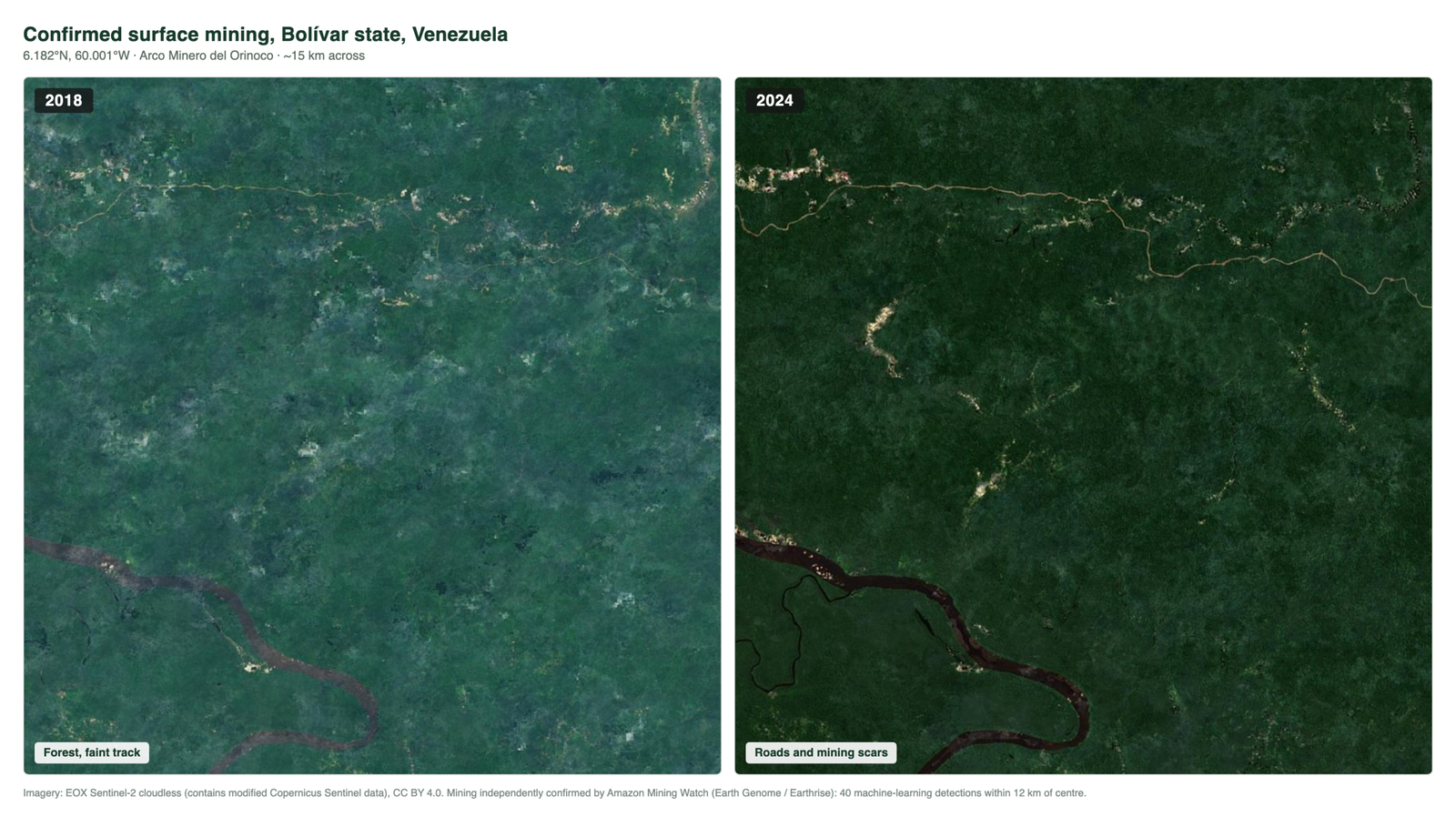
These minerals are dug by surface mining: rather than tunneling, miners strip the forest and topsoil off the deposit and blast the exposed ground into slurry with high-pressure water hoses. The heavy target minerals, cassiterite, coltan, rare-earth sands, gold, are then washed out and separated by weight into concentrate, the enriched, export-ready powder that is far lighter than raw ore and ships onward to smelters, frequently in China.
What stays is the pale, barren scarring now visible from orbit across Bolívar and Amazonas: ground stripped of vegetation and organic matter, often acidified and laced with mercury, that does not recover. A healthy tropical soil greens over in a single wet season; sterilized mining ground stays white for years. The concentrate leaves. The dead land stays.
The Colombia caveat, stated plainly
Honesty requires leading with the uncomfortable finding. For a Journal watching the Colombian Amazon, the awkward truth is that this is the one place the China-illegal-mining link is not documented. Illegal gold in Putumayo, Caquetá and Guaviare is run by FARC dissidents, the ELN and local mafias, with no reported Chinese financing. The only Colombian case in the record is the inverse of the thesis: a Chinese-owned legal mine, Zijin's operation at Buriticá, being robbed by illegal miners (Swissinfo). Colombian gold is laundered into global markets that include China, but that is market demand, not Chinese facilitation of Colombian criminals. Any piece claiming otherwise for Colombia would be overreaching the evidence.
What we can and cannot say
Two cautions. First, evidence quality varies: the Guianas and Bolivia rest on field investigations and export records; the Venezuela link rests substantially on miner testimony ("miners say"), which we report as testimony, not proof. Second, the frame matters. This is a story about supply-chain nodes and named firms, not about an ethnicity. The rigorous claim is that specific Chinese-run trading networks and buyers occupy a critical, largely legal-facing position in an illegal economy. The careless claim, that "the Chinese" are behind Amazon mining, is both false and ugly, and the evidence does not support it. For wider context on how these economies actually work, see InsightCrime and the regional overview in Raia Diplomática.
Timeline
- 2019–2021: Bolivia's gold exports surge under lax controls as Chinese-backed dredging expands.
- Nov 2022: Los Tiempos exposes dozens of Chinese firms behind Bolivian cooperatives.
- Sep 2023: FR Stratégie's "Gilded Shadows" documents 120 Chinese trading posts on the Maroni.
- 2023–2025: Venezuela builds strategic-mineral hubs in Bolívar; tin and coltan flow to Chinese smelters.
- Jul 2024: Guyana arrests three Chinese nationals in a gold-smuggling ring.
- Aug 2025: Brazil's largest gold busts (Roraima, Pará) linked to onward flows toward China.
- Nov 2025: InfoAmazonia maps the critical-minerals route connecting the Amazon to China.
- Jan–Feb 2026: Peru's tailings-to-China scheme exposed; Interpol's cross-border operation yields 198 arrests.
Why it belongs in the corridor story
Read on its own, this is a mining-crime story. Read alongside the Trans-Amazonian Highway, the BR-319 tipping-point road, the bioceanic railway and Chancay, it is one more layer of the same map: the routes that open the forest, and the demand that pulls its minerals, mercury and gold out through them. Track it in the Amazon Corridors Watch.
Sources
- Brazil: Infobae (China in Brazil's illegal gold).
- Bolivia: Infobae / Los Tiempos, ANA Bolivia, Climate Diplomacy.
- Guianas: Le Monde (on the FR Stratégie report), Interpol, Global Americans, The Guardian, Stabroek News.
- Venezuela and strategic minerals: InfoAmazonia, Diálogo Américas.
- Peru (outside the Amazon): OjoPúblico, Infobae.
- Colombia caveat: Swissinfo (Zijin robbery).
- Mercury and context: EIA, "Toxic Tons", InsightCrime, Raia Diplomática.
Editor's note: This dossier adapts a source-referenced research document and re-verifies its citations. Two links required repair. The keystone French Guiana study, the Foundation for Strategic Research's "Gilded Shadows" (2023), is named in the text but its PDF was unreachable at publication; its central findings are anchored here to Le Monde's English summary and corroborated by the 2026 Interpol operation. A Bolivia source that blocked access was replaced with Infobae's full republication of the same Los Tiempos investigation, plus ANA Bolivia. The before/after satellite figure was built from license-clean EOX Sentinel-2 cloudless imagery, with its location independently confirmed against Amazon Mining Watch mining detections; no embeddable video met our sourcing bar, so the strongest additional visual reporting is linked above. Evidence quality is graded in the text, and testimonial claims are marked as such.
About the Byline
About the Investigations Desk
The Colombian Amazon Journal Investigations Desk examines environmental governance, extractive industries, infrastructure, territorial conflict, Indigenous rights, and threats affecting Amazonian communities. Institutional bylines may be used where identifying an individual contributor could create unnecessary risks for writers, sources, or community partners.
Read our Editorial Standards →