
You do not live in the Amazon. You may never see it. And its collapse would still reach into your life, through the price of your food, the stability of your climate, and the speed at which the planet you depend on becomes harder to live on. The developments now unfolding in the Amazon are not a regional environmental story. They are a global emergency moving in slow motion, and the window to notice is closing.
In this reportJump to a section
Start with scale. The Amazon spans nine countries, holds one of the largest concentrations of life on Earth, and drives rainfall and climate far beyond its own borders (Science Panel for the Amazon; SPA on flying rivers). It is not a passive backdrop. It is machinery. The forest recycles its own moisture and pumps it across the continent in atmospheric "flying rivers" that water the farms feeding much of South America, and whose failure would ripple into global food and commodity markets (Science Panel for the Amazon). It stores an enormous quantity of carbon that, released, would accelerate warming for every person on the planet.
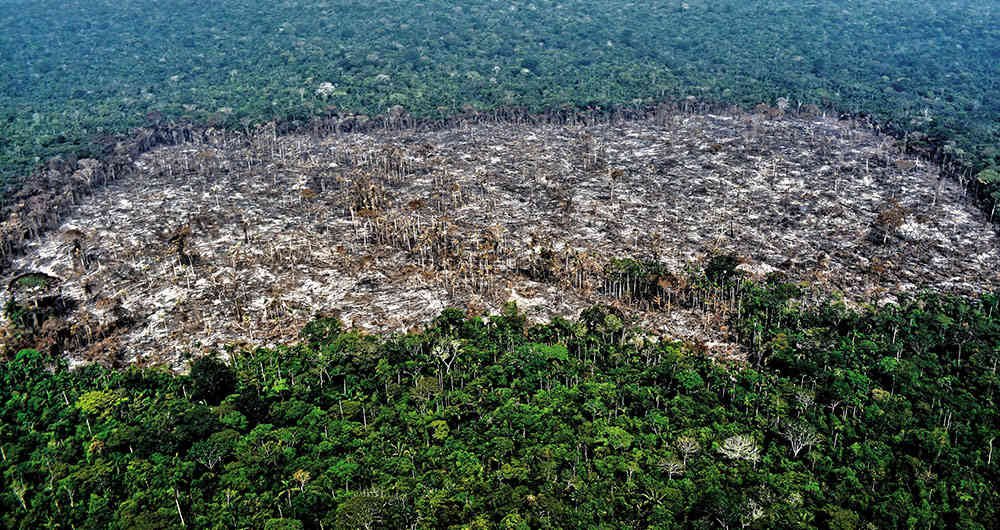
The threshold is not theoretical, and it is near
Scientists have identified a point of no return. If deforestation passes roughly 20 to 25 percent of the Amazon, large sections could tip irreversibly from rainforest toward dry, degraded savannah (Science Panel for the Amazon, 2025). Roughly 17 to 18 percent has already been cleared. That is not a comfortable margin. It is a handful of percentage points, and recent modelling warns the tipping point could arrive as early as the 2040s, ultimately transforming more than 70 percent of the basin (Mongabay, 2026).
The forest is already changing beneath us. Parts of the Amazon, under pressure from deforestation, fire and heat, have flipped from absorbing carbon to releasing it, from a brake on climate change into an engine of it (Nature, 2021). This is the quiet horror of a tipping point: by the time it is obvious, it is already too late to reverse on any human timescale.
What is driving it is accelerating, not slowing
Cattle ranching and soy farming still consume vast areas of forest to satisfy global demand. But the newest threats are in some ways worse, because they poison what they do not clear. Illegal gold mining has spread across the basin, and with it mercury, dumped into rivers and carried into the fish that tens of millions of people eat.
The numbers are not abstract. A Fiocruz study found that more than a fifth of fish sold in Amazon markets exceeded World Health Organization mercury limits, with young children consuming mercury at levels up to 31 times the recommended maximum (PBS). Among the Yanomami, testing found 84 percent of people carried mercury at or above harmful levels (EIA). A systematic review of Indigenous Amazonian communities documented hair-mercury averages far above the safe threshold across Brazil, Colombia and Peru (Environmental Science and Pollution Research, 2025). The Yanomami are simply the most-documented case. In the Colombian Amazon this Journal reports from, the same convergence of gold, mercury, deforestation and armed pressure bears down on peoples such as the Wacara of the Vaupés and the Nukak of the Guaviare, one community at a time. This is a neurotoxin, concentrating in the bodies of children, in territory the outside world treats as remote.
On top of gold comes a new frontier: rare earth and strategic minerals, sought for the very technologies marketed as the clean-energy future, now eyed in the Brazilian Amazon (Harvard ReVista). Major infrastructure in the Amazon, such as hydroelectric dams and roads, has led to extensive deforestation, ecosystem degradation and the establishment of illegal economies (Science Panel for the Amazon). Mining alone already covers more than 20% of Indigenous lands in the Amazon and is polluting at least 30 Amazonian rivers (WRI).
The people holding the line
More than 47 million people live in the Amazon, including millions of Indigenous people whose food, health, knowledge and cultural survival are inseparable from the forest and its rivers (Science Panel for the Amazon). They are not victims to be pitied from a distance. They are the most effective defence the forest has. Research reviewed by the FAO found that Indigenous and tribal territories with recognised collective land rights have measurably lower deforestation, that the forest simply stands where their rights are secure (FAO). Every mercury-poisoned river and every illegal road is therefore not only an ecological loss. It is an attack on the people best positioned to keep the whole system standing.
Why this is your emergency too
Here is the part that clichés obscure. The Amazon is not "the lungs of the Earth," a comforting phrase that lets distant people file it under someone else's concern. It is a living climate system, and if it is pushed past its threshold, the consequences do not stay in South America. Rainfall patterns shift. A vast carbon store empties into the atmosphere, worsening the warming that is already destabilising harvests and coastlines everywhere. Biodiversity that took millions of years to assemble does not come back (WWF; Science Panel for the Amazon).
A degraded Amazon means a harder planet to live on, for people who have never heard of the rivers now running with mercury. That is the honest reason everyone on Earth should be worried: not sentiment about a faraway jungle, but the physics of a shared life-support system being dismantled for short-term profit.
What worry has to become
Concern that stays a feeling changes nothing. It has to become demand. Demand for deforestation-free supply chains, so that the beef, soy, gold and minerals in the global economy stop financing the burning. Demand that Indigenous land rights be recognised and defended, because that is where the forest survives. Demand that governments and companies halt the extraction and contamination that are poisoning rivers and pushing the system toward the edge (FAO; Science Panel for the Amazon).
There are no simple solutions. But the bottom line is not complicated, and it is not optional: the health of the Amazon is inseparable from the health of our world. We are close to the line. What we do in this decade decides which side of it our children inherit.
Sources: WWF, Risking the Amazon; Science Panel for the Amazon, Amazon Assessment Report 2025 and the flying-rivers analysis; Nature (2021), Amazonia as a carbon source; FAO, Indigenous and Tribal Peoples as forest guardians; Harvard ReVista, rare-earth minerals in the Brazilian Amazon; EIA, Mercury Emergency in the Amazon; Environmental Science and Pollution Research (2025), mercury contamination of Indigenous Amazonian communities; WRI, mining and Indigenous lands; Mongabay (2026) and PBS on the tipping-point timeline and the mercury and gold-mining rush.

Trackbacks/Pingbacks