
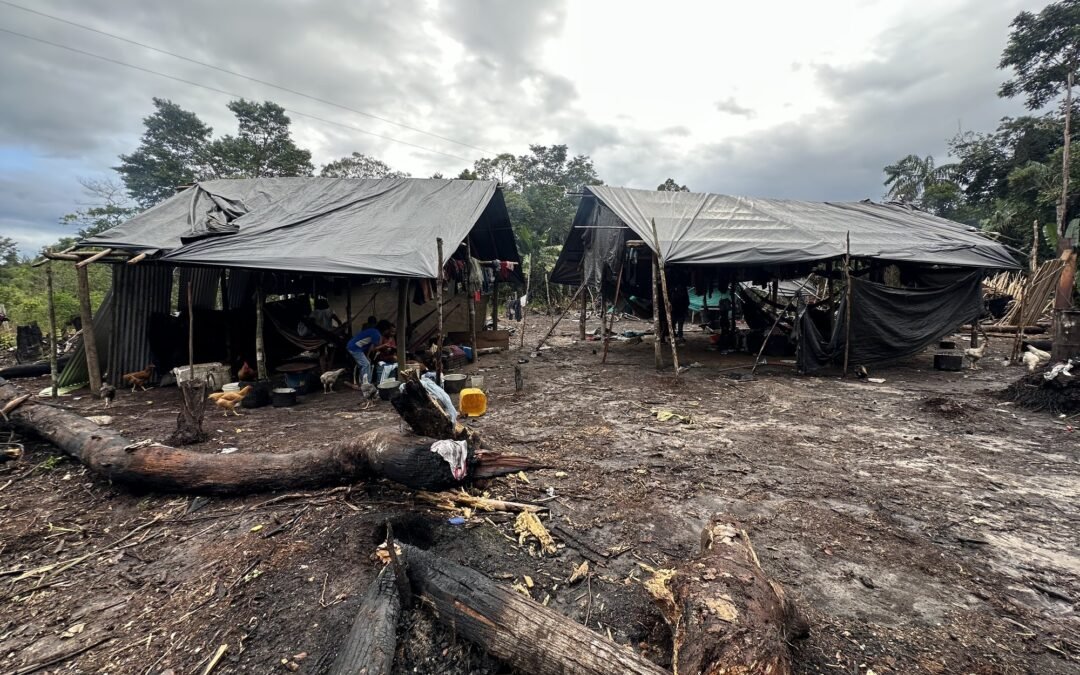
A Nukak camp on cleared ground in the Colombian Amazon, May 2026. Photograph by CAJ Staff Photographer.
In this reportJump to a section
An investigation by Earth Journalism Network, "Gold of Abandonment," documents how Indigenous communities along the Inírida River in Guainía, Colombia, came to depend on informal gold mining after the state left them with little else. It is a careful, humane piece of reporting, and its hardest finding is chemical: Guainía may now be the most mercury-poisoned place in the country. This piece preserves what that reporting shows, then does something the article does not: it follows the same mining frontier upriver, toward the territory of the Nukak, one of the last nomadic peoples in the Amazon and one the Constitutional Court has warned is facing physical and cultural extinction. Where the public record is solid, it is cited. Where it thins, that is said plainly.
What the reporting shows in Guainía
In Chorrobocón, an Indigenous community on the banks of the Inírida, informal gold mining is the main livelihood. Dredging rafts, balsas, pull gold from the riverbed, and the community's own captain explains why plainly: mining is how they get the money to live (El Morichal; original: Earth Journalism Network). The reporting is careful not to caricature this. It is not greed; it is what remains after decades of state absence. Guainía is almost entirely Indigenous territory, most of it resguardos of the Puinave and Curripaco peoples, and for many communities mining has been the one reliable economy for a generation. Some who do not mine still live off it, selling food to the rafts.
Two harder facts sit underneath. First, the gold comes as fine flakes, so miners use mercury to separate it, even though Colombia banned mercury in gold mining in 2019 under the Minamata Convention. Communities say they are now more careful, burying contaminated residue away from the river. But studies by the regional health secretariat and the environmental authority (CDA) found high mercury levels in people, fish, plants and river sediment, and a toxicologist quoted in the reporting believed Guainía was likely the most mercury-contaminated place in Colombia. Second, the trade is criminal and coerced: the United Nations has estimated that some 95 percent of the region's gold is extracted illegally, and local miners describe paying extortion to armed groups that "manage the illicit economy" and keep communities intimidated. This is survival mining wrapped inside an armed economy, poisoning the water it depends on.
Mining titles have added a further fracture. Concessions have been granted over Guainía resguardos, sometimes registered in Indigenous people's names without their consultation, splitting communities from within (Vorágine; Mongabay).
The people the article does not mention
The Earth Journalism piece is about the Puinave and Curripaco communities of the Inírida. It does not mention the Nukak. But the same interfluve between the Inírida and Guaviare rivers, where this mining economy operates, is the Nukak's world, and they are not like the communities in the story. The Nukak are among the last nomadic hunter-gatherers in the Amazon, a people who moved through the forest dozens of times a year and were only brought into sustained contact with the outside world in the late 1980s. They have no tradition of mining, no cash economy to fall back on, and almost no capacity to absorb a frontier economy pressing into their forest.
That fragility is not a matter of interpretation. In its Auto 004 of 2009, Colombia's Constitutional Court warned that the Nukak were among the peoples at imminent risk of physical and cultural extermination from the armed conflict and forced displacement, and ordered the state to act to protect them. The ruling did not end the crisis: in 2016, Mongabay reported some 200 Nukak families displaced from their reserve and struggling to return to their land so as not to disappear, after forced displacement documented as early as 2008 (Mongabay; CAJAR). This is the context the Journal has tracked in its Nukak Territorial Spotlight.
Where the frontier meets the Nukak: a corridor through their reserve
The geography is the argument. Running straight through their reserve is an illegal corridor of dozens of kilometres that connects the Inírida River, the mining river of the Guainía story, to the Guaviare. It was once a Nukak footpath for gathering medicine, fruit and food. It is now a strategic route for FARC-dissident factions moving cocaine precursors and weapons, and it has become an axis of destruction: the Foundation for Conservation and Sustainable Development records some 36,510 hectares of the Nukak territory deforested between 1990 and mid-2025, more than 500 kilometres of illegal roads cut across the reserve, and coca and cattle advancing behind them (El Espectador; Mongabay).
The human toll on the Nukak along this corridor is documented and severe: forced displacement, the recruitment of minors (United Nations monitors recorded child recruitment and the deaths of Nukak minors in fighting between armed groups in early 2025), sexual violence against Nukak women, and a people now forced to ask armed men or ranch workers for permission to move through land that was theirs. That the state's own environmental and human-rights bodies have flagged the collision of isolated and recently contacted peoples with mining is not new (UN Human Rights, Colombia).
The mercury they did not choose
Here the two stories join. The Guainía reporting establishes that the Inírida's water, fish and sediment carry some of the highest mercury burdens in the country. The Nukak, when they are in their territory, live from that forest and those waters, they fish, they forage, they drink. A people already pushed to the edge by war and displacement is also, by every indication, exposed to a contamination they had no part in creating and no way to avoid. Mercury does not respect a reserve boundary; it moves downstream and up the food chain into whoever eats the fish. This is the same mercury logic the Journal has traced across the Amazon's mining economies, from the Guianas to Venezuela, in its investigation into the networks that supply the mercury and buy the gold. In Guainía, the chain ends at one of the most vulnerable peoples on the continent.
What the record does not yet show
Honesty requires marking the limit. The public record documents, in detail, two things: the informal gold-and-mercury economy of the Inírida communities, and the coca, deforestation and displacement inflicted on the Nukak along the corridor through their reserve. What it does not yet document is the direct, specific impact of the gold-mining and mercury frontier on the Nukak themselves within their reserve. That link, geographically obvious and consistent with everything the reporting shows, has not been the subject of published investigation. It is the story that still needs telling, and it is where reporting must be led by the people who live it, not asserted from outside. We flag the gap rather than fill it with speculation.
Questions that follow
- Have the mercury studies in Guainía tested Nukak individuals, or only the settled Inírida communities?
- How far up the Inírida, toward their reserve, does the dredging and mercury frontier now reach?
- Do the armed groups that tax the Guainía miners also control the corridor through their reserve, making it one economy, not two?
- What, concretely, has the state done to meet the protection ordered for the Nukak in Auto 004 of 2009, and has any of it addressed mining or mercury?
- Are Nukak people being drawn, by the same abandonment that pulled the Inírida communities in, into mining labour on others' terms?
The honest bottom line
For the communities in "Gold of Abandonment," informal mining is not a crime of ambition but the residue of neglect: the state left, and the river was what remained. For the Nukak, the same frontier is something worse. They have no fallback economy, no cash cushion, no long practice of extraction to fall back on, and a Court has already said they may not survive the pressures now closing around them. The Inírida communities were failed into mining. The Nukak are being crushed between mining, coca, cattle and guns, on land whose contamination they did not choose. If Guainía is the most mercury-poisoned place in Colombia, then the people least able to withstand it are living at its upstream edge. That is the part of this story the headlines have not yet reached.
Sources
- The article: Earth Journalism Network, "Gold of Abandonment" (Edwin Suárez); accessible Spanish version at El Morichal.
- Guainía mining titles and Indigenous lands: Vorágine, Mongabay.
- The Nukak, the corridor, and the crisis: Constitutional Court, Auto 004 of 2009, El Espectador, Mongabay, CAJAR, UN Human Rights, Colombia.
Editor's note: This piece adapts and extends published reporting. The Earth Journalism Network investigation concerns the Inírida communities of Guainía and does not itself discuss the Nukak; the Nukak dimension here is built from separate, cited sources on the corridor through their reserve and the Constitutional Court record. Every link was verified. We have deliberately not named specific Nukak settlements or pinpointed their locations, both because those details are not in the public record and because naming them could expose an already endangered people. Where the direct mining-and-mercury impact on the Nukak has not been documented, we say so rather than assert it.
Part of: The Colombian Amazon
About the Byline
About the Investigations Desk
The Colombian Amazon Journal Investigations Desk examines environmental governance, extractive industries, infrastructure, territorial conflict, Indigenous rights, and threats affecting Amazonian communities. Institutional bylines may be used where identifying an individual contributor could create unnecessary risks for writers, sources, or community partners.
Read our Editorial Standards →